Dragonflies and Damselflies: Model Organisms for Ecological and Evolutionary Research
Book information
Description
This research level text documents the latest advances in odonate biology and relates these to a broader ecological and evolutionary research agenda. Despite being one of the smallest insect orders, dragonflies offer a number of advantages for both laboratory and field studies. In fact, they continue to make a crucial contribution to the advancement of our broader understanding of insect ecology and evolution. This new edition provides a critical summary of the major advances in these fields. The editors have carefully assembled a fresh set of contributions from a diverse geographic mix of both junior and senior researchers in dragonfly biology to offer new perspectives and paradigms as well as additional, unpublished data. These include theoretical and applied chapters (including those addressing conservation and monitoring) as well as a balance of emerging (e.g. molecular evolution) and established research topics, providing suggestions for future study in each case. This accessible text is not about dragonflies per se but is an essential source of knowledge that describes how different sets of evolutionary and ecological principles and ideas have been tested on a particular taxon. Dragonflies and Damselflies is suitable for graduate students and researchers in entomology, evolutionary biology, population and behavioural ecology, community ecology, and conservation biology. It will be of particular interest and use to those working on insects and an indispensable reference text for odonate biologists. Cover Titlepage Copyright List of Contributors List of Reviewers Contents Foreword 1 Introduction to Dragonflies and Damselflies, Second Edition SECTION 1 Genomics SECTION EDITOR: Alex Córdoba-Aguilar 2 Genomic insights into micro- and macro-evolutionary processes in Odonata 2.1 Introduction 2.2 Genomic insights into population processes 2.2.1 Dispersal and connectivity 2.2.2 Range shifts and other spatial processes 2.3 Adaptation and adaptive trait evolution 2.3.1 Environmental adaptation 2.3.2 Morphological adaptation 2.3.3 Life stage-specific adaptation 2.4 Genomic variation associated with hybridization and speciation 2.4.1 Insights from genome assemblies into species- and order-specific functional traits 2.5 Conclusions and future directions References 3 Transcriptomic insights into Odonata ecology and evolution 3.1 Introduction 3.2 Color vision 3.3 Transcriptomic insight into the eco-evolutionary role of color variation 3.3.1 Ecological significance of color variation within and between species 3.3.2 Evolution of color phenotypes 3.3.3 Pigments 3.3.4 Structural colors 3.3.5 Genes involved in body color formation 3.4 Embryogenesis 3.4.1 Gene expression during embryogenesis 3.5 Phylo-transcriptomics 3.6 Future directions 3.6.1 Color vision 3.6.2 Color 3.6.3 Embryogenesis 3.6.4 Phylogenomics 3.7 Conclusion Acknowledgments References SECTION 2 Organismal Studies 4 Functional morphology in Odonata 4.1 Introduction 4.2 Head 4.3 Head–thorax articulation 4.4 Thorax 4.5 Wings 4.6 Legs 4.7 Abdomen Method Boxes References 5 The biomechanics of odonate flight 5.1 Flight mechanics 5.2 Muscle activation 5.3 Wing structure 5.4 Flapping wing aerodynamics 5.4.1 Leading-edge vortex 5.4.2 Stroke plane 5.4.3 Planform 5.5 Aerodynamic interactions 5.5.1 Wing phasing 5.6 Flight control and sensing 5.6.1 Passive control 5.6.2 Active control 5.6.3 Predicting sensory inputs 5.7 Concluding remarks Acknowledgments References 6 Odonata immunity, pathogens, and parasites 6.1 Introduction 6.2 Parasites 6.2.1 Viruses 6.2.2 Bacteria 6.2.3 Gregarines 6.2.4 Trematodes 6.2.5 Water mites 6.2.6 Parasitoids 6.2.7 Coinfection 6.3 Odonate immunity 6.3.1 Overview of insect immunity 6.3.2 Components of odonate immunity 6.4 Ecology and evolution of immunity and parasites 6.4.1 PO and food webs 6.4.2 Metacommunity structure 6.4.3 Coevolution 6.5 Future research directions 6.5.1 Genetics 6.5.2 Microbiome 6.5.3 Climate change 6.6 Conclusions Acknowledgments References 7 Odonata perception is more than vision 7.1 Introduction 7.2 Adult 7.2.1 Antennae 7.2.2 Mouthparts and gustatory sensilla 7.2.3 The ovipositor sensilla: sensing the plant taste and stiffness 7.3 Nymph 7.3.1 Antennae 7.4 Conclusions and future perspectives References 8 Thermoregulation in Odonata 8.1 Introduction 8.2 Mechanisms of thermoregulation 8.2.1 Ectothermy and behavior 8.2.2 Ectothermy and color 8.2.3 Endothermy 8.3 Global change and thermal limits 8.4 Global change and body coloration 8.5 Odonate resilience: a link to thermoregulation? 8.6 Linking thermoregulation mechanisms to global temperature changes 8.7 Some topics for future thermoregulation research 8.7.1 Genetics and physiology of thermoregulation 8.7.2 Mechanisms of thermoregulation 8.7.3 Trade-offs between thermoregulation and other functions 8.7.4 Human awareness via insect thermoregulation risk under climate change Acknowledgments References SECTION 3 Population Ecology: Christopher D. Beatty 9 Genetic structure, cryptic species, and hybridization causes and evolutionary consequences in Odonata 9.1 Introduction 9.2 Gene flow within species: population genetic structure in odonates 9.3 Cryptic species in odonates 9.4 Gene flow between species: hybridization in odonates 9.5 Conclusions and research directions Acknowledgments References 10 Odonata survival 10.1 Introduction 10.2 The effect of marking 10.3 A review of the literature using marking methods with odonates 10.4 The effect of sex and age on survival and recapture rates 10.5 The effect of female color polymorphism 10.6 Individual and environmental covariates 10.7 Conclusions and further research Acknowledgments References 11 Migration in Anisoptera 11.1 Introduction 11.2 Migratory case studies in odonates 11.2.1 Anax junius 11.2.2 Pantala flavescens 11.3 Migration and weather 11.4 Migration and reproduction 11.5 Population studies in migrating dragonflies 11.6 Migrants vs. residents—how might they evolve? 11.7 Future directions Acknowledgments References 12 Dispersal and metapopulation ecology in Odonata 12.1 Dispersal biology in ecology and evolution 12.2 Dispersal biology in Odonata 12.3 Methods for studying dispersal in odonates 12.4 Dispersal and population structure 12.4.1 Context- and phenotype-dependent dispersal 12.4.2 Spatially structured populations 12.4.3 Dispersal and species ranges 12.5 Dispersal and colonization in the Anthropocene 12.5.1 Effects of human alteration of matrix environments on dispersal and habitat colonization 12.5.2 Colonization and ecological traps 12.6 Future research directions in the study of dispersal in Odonata 12.6.1 Dispersal in the context of anthropogenic change 12.6.2 Rapidly advancing methods 12.6.3 Research across a greater diversity of the world's landscapes Acknowledgments References 13 Biogeographical ecology in Odonata 13.1 Introduction to biogeography 13.1.1 Biogeographical concepts through history 13.1.2 Historical and ecological biogeography 13.2 Biogeographic realms and odonate species distributions 13.2.1 Nearctic 13.2.2 Palearctic 13.2.3 Indo–Malayan 13.2.4 Australasia 13.2.5 Oceanic–Pacific 13.2.6 Afrotropics 13.2.7 Neotropics 13.3 Factors influencing odonate distributions 13.3.1 Climatic factors 13.3.2 Precipitation 13.3.3 Temperature 13.3.4 Tracking suitable climates: differences in temperature causes different species compositions 13.3.5 Geographic barriers 13.3.6 Mountains and plains 13.3.7 River basins 13.3.8 Glaciation patterns 13.4 Considerations of scale in odonate biogeographical analysis 13.5 Life history evolution in odonate biogeography 13.5.1 Latitudinal differences in voltinism 13.5.2 Latitudinal patterns in thermal adaptation and space-for-time substitution studies 13.6 Conservation Biogeography 13.7 Future directions Acknowledgments References SECTION 4 Community Ecology 14 Evolutionary community ecology of Odonata 14.1 Introduction 14.2 Interactions in odonates 14.2.1 Predation—odonates as prey 14.2.2 Predation—odonates as predators 14.2.3 Competition 14.2.4 Parasitism 14.2.5 Reproductive interactions 14.3 Natural and sexual selection in communities 14.3.1 Selection in larvae 14.3.2 Selection in adults 14.4 Eco-evolutionary effects in communities 14.4.1 Adaptation to biotic interactions 14.4.2 Adaptation during range expansion 14.5 Future directions and conclusion Acknowledgments References 15 Ecological differentiation, interference, and coexistence in Odonata 15.1 Introduction 15.2 Coexistence theory 15.2.1 Local coexistence 15.2.2 Regional (non-local) coexistence 15.2.3 Interspecific interference and coexistence 15.2.4 Intraspecific interference and coexistence 15.3 Empirical studies on coexistence and competition in Odonata assemblages 15.3.1 Local coexistence 15.3.2 Regional coexistence 15.3.3 Exploitative competition among larvae 15.3.4 Interference competition among larvae 15.3.5 Interspecific aggressive and reproductive interference at the adult stage 15.3.6 Intraspecific interference at the adult stage 15.4 Conclusions and recommendations Acknowledgments References 16 Odonata trophic ecology from hunting behavior to cross-ecosystem impact 16.1 Introduction 16.2 Background to odonate trophic ecology 16.2.1 Trophic role of odonates in aquatic food webs 16.2.2 Odonate hunting behavior 16.2.3 Visual, chemical, and olfactory cues 16.3 Shifts and variation in odonate trophic relations 16.3.1 Ontogenetic scaling and trophic niche shifts 16.3.2 Sex differences in adult diet 16.3.3 Carryover effects of larval diet on adult phenotypic traits and fitness 16.3.4 Carryover effects of predation risk on adult traits 16.3.5 Metamorphosis and shifts from aquatic to terrestrial diets 16.4 Trophic and non-trophic interactions in food webs 16.4.1 Cannibalism and intraguild predation (IGP) 16.4.2 Non-trophic interactions 16.4.3 Trophic cascades and cross-ecosystem fluxes 16.5 Importance of abiotic factors in odonate trophic ecology 16.6 Eco-evolutionary dynamics of trophic interactions 16.7 Conclusions and research directions Acknowledgments References 17 Metacommunity concepts, approaches, and directions with Odonata 17.1 Introduction to metacommunity thinking 17.2 Why odonates? 17.3 Some current themes in odonate metacommunity ecology 17.4 Empirical approaches to metacommunities 17.4.1 Experimental approaches 17.4.2 Observational approaches 17.4.2.1 Disentangling assembly patterns 17.4.2.2 Disentangling assembly processes 17.5 Future directions 17.5.1 Applied metacommunity thinking 17.5.1.1 Mass effects and bioassessment 17.5.1.2 Mass effects and spatial prioritization 17.5.1.3 Dispersal limitation and ecological restoration 17.5.2 Importance of historical factors 17.5.3 Toward a more high-tech and integrative metacommunity ecology Acknowledgments References 18 Odonata assemblages in human-modified landscapes 18.1 Introduction 18.2 General challenges and methods 18.3 Logging, agriculture, and non-urban secondary habitats 18.3.1 Logging 18.3.2 Agriculture 18.3.3 Non-urban secondary habitats 18.4 Urban landscapes 18.4.1 Water in urban landscapes 18.4.2 Urban heat island (UHI) effect 18.4.3 Urban ecological traps 18.5 Challenges and future directions Acknowledgments References SECTION 5 Diversity, Systematics, and Bioinformatics 19 Species identification and description 19.1 Introduction 19.2 Species identification in Odonata 19.3 General topics in the taxonomic literature and their implication for Odonata 19.3.1 Taxa as concepts 19.3.1.1 Species 19.3.1.2 Subspecies 19.3.1.3 Taxonomic ranks below subspecies in Odonata 19.4 When is a species ``new''? 19.4.1 Species delimitation in Odonata 19.4.2 Patterns of description in Odonata 19.5 Species description 19.5.1 Details included in the description 19.5.2 Naming taxa (assigning a nomen to a concept) 19.5.3 Role of the name-bearing specimens 19.6 Conclusions and suggestions for students in Odonata taxonomy and nomenclature Acknowledgments References 20 The Odonatoptera a clade that contains 99% of Odonata fossil diversity 20.1 Definition of the Odonatoptera as a superorder 20.2 Major subdivisions of the Odonatoptera 20.3 What are the fossil remains of Odonatoptera? 20.4 A diversity of wing venations: a diversity of flight patterns? 20.5 Paleoecology and diversity changes since the Carboniferous 20.6 Conclusion Acknowledgments References 21 Odonata systematics 21.1 Introduction 21.2 Odonata systematics through time 21.2.1 Traditional systematics through morphology 21.2.2 Molecular renaissance 21.3 The modern Odonata tree of life 21.3.1 Zygoptera 21.3.2 Anisozygoptera 21.3.3 Anisoptera 21.3.4 Why are some nodes difficult to resolve? 21.4 Beyond systematics: phylogenies as a tool for studying Odonata evolution 21.4.1 Divergence time estimation and diversification analysis 21.4.2 Biogeographical analysis 21.4.3 Phylogenies for studying trait evolution 21.5 What systematics cannot do 21.6 Future of Odonata systematics Acknowledgments References 22 Phylogeography A spatiotemporal perspective on Odonata distributions 22.1 Introduction 22.2 A global perspective: historical biogeography 22.3 Phylogeographic patterns within biogeographic realms 22.3.1 Holarctic 22.3.2 Neotropical 22.3.3 Afrotropical 22.3.4 The Indo–Australian Archipelago 22.3.5 Oceanic–Pacific 22.4 Current limitations and future perspectives Acknowledgments References 23 Odonata collections and databases 23.1 Introduction 23.2 The foundational odonate taxonomists 23.2.1 Carolus (Carl) Linnaeus (1707–1778) 23.2.2 Jules Pierre Rambur (1801–1870) 23.2.3 Michael Edmond de S"00E9lys Longchamps (1813–1900) 23.2.4 Hermann August Hagen (1817–1893) 23.2.5 Friedrich Ris (1867–1931) 23.2.6 Philip Powell Calvert (1871–1961) 23.2.7 Frederic Charles Fraser (1880–1963) 23.2.8 Maurits Anne Lieftinck (1904–1985) 23.3 Physical collections 23.4 Extending physical collections 23.4.1 Community science 23.4.2 Digital collections 23.5 Odonate databases and Big Data 23.5.1 Specimen digitization 23.5.2 Spatial data 23.5.3 Taxonomic data 23.5.4 Genetic/phylogenetic data 23.5.5 Trait data 23.6 Conclusions Acknowledgments References SECTION 6 Applied Ecology and Conservation 24 Linking traits to extinction risk in Odonata 24.1 Introduction 24.2 General considerations for studying trait-based Odonata extinction risk 24.2.1 Commonly studied odonate traits 24.3 An ecological and evolutionary perspective on trait variation 24.3.1 A functional ecological perspective 24.3.2 A functional evolutionary perspective 24.4 Community resilience and functional redundancy 24.5 Traits as predictors and proxies of extinction risk 24.6 Conclusions and future directions Acknowledgments References 25 Odonata as surrogates of biodiversity 25.1 Introduction 25.1.1 The history and terminology surrounding surrogacy 25.1.2 Chapter outline 25.2 Characteristics of good biodiversity surrogates 25.3 Dragonflies as biodiversity surrogates 25.3.1 Importance of life stage 25.3.2 Single-taxon surrogacy and self-surrogacy 25.3.3 Multi-taxa surrogacy approaches and congruence with co-occurring taxa 25.4 Challenges and opportunities 25.4.1 Sampling methods 25.4.2 Quantifying surrogate success 25.4.3 Managing the limitations of surrogacy 25.5 Conclusion Acknowledgments References 26 Odonata as indicators of pollution, habitat quality, and landscape disturbance 26.1 Introduction 26.2 Sampling considerations 26.2.1 Nymphs, exuviae, or adults? 26.2.2 Importance of long-term monitoring 26.3 Odonata as environmental health indicators 26.3.1 Pollution bioassessment 26.3.1.1 Ecotoxicology 26.3.1.2 Bioaccumulation in sentinel organisms 26.3.1.3 Pollution biotic indices 26.3.2 Habitat quality assessment 26.3.2.1 Dragonfly Biotic Index (DBI) 26.3.2.2 Lotic habitat quality 26.3.2.3 Assessing tropical forest habitat degradation via coarse taxonomic ratios 26.3.3 Landscape disturbance assessment 26.4 Toward large-scale environmental health assessments 26.4.1 Sensitivity traits 26.4.2 Citizen science Acknowledgments References 27 Odonata as focal taxa for biological responses to climate change 27.1 General introduction and chapter outline 27.2 Climatic drivers of diversity patterns 27.3 Biogeographical processes shaping diversity patterns 27.4 Mechanisms underpinning species' responses to climate change 27.5 Trait-based analysis of range shifts, population trends, and phenological changes 27.5.1 Range shifts 27.5.2 Population trends 27.5.3 Phenological changes 27.6 Climate change and competition 27.7 Climate change and habitat loss as threats to Odonata diversity 27.8 Modeling species distributions and their dynamics 27.9 Conclusions Acknowledgments References 28 Odonata as focal taxa for ecological restoration 28.1 Introduction 28.2 General principles and challenges of restoration practice 28.3 General considerations for restoring odonate populations and assemblages 28.4 Odonate-based habitat restoration 28.4.1 Lotic habitats 28.4.2 Lentic habitats 28.4.3 Mixed lentic and lotic habitats 28.5 Restoration progress and odonates as management indicators 28.5.1 Odonates as indicators of restoration progress 28.6 Restoration by translocation 28.7 Conclusions and directions Acknowledgments References 29 Bridging people and nature through Odonata 29.1 Introduction 29.2 Odonata in ecotourism 29.3 Odonata in childhood environmental education 29.4 Defining Odonata species ranges using community science 29.5 Odonata conservation listing 29.5.1 IUCN Red List of Threatened Species 29.5.2 Odonata and the Red List 29.5.2.1 Africa 29.5.2.2 Latin America 29.6 Territorial empowerment via Odonata 29.7 The EDI barrier to globalized odonatology 29.7.1 International collaborations 29.7.2 Reconsidering the publishing process 29.7.3 International research funding and surveys 29.7.4 Giving back 29.8 Conclusion Acknowledgments References Glossary Subject Index
Similar books
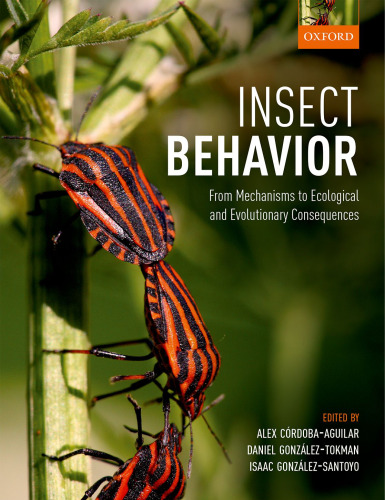
Insect behavior. From mechanisms to ecological and evolutionary consequences
2018 · PDF

Insect Behavior: From Mechanisms to Ecological and Evolutionary Consequences
2018 · PDF

The Evolution of Primary Sexual Characters in Animals
2010 · PDF

Dragonflies and Damselflies: Model Organisms for Ecological and Evolutionary Research
2009 · PDF

Dragonflies and Damselflies: Model Organisms for Ecological and Evolutionary Research
2008 · PDF

MySQL® Notes for Professionals book
2018 · PDF

MrExcel 2022: Boosting Excel
2022 · PDF

MrExcel 2022: Boosting Excel
2022 · PDF