Modern Cryptography Volume 1: A Classical Introduction To Informational And Mathematical Principle
Book information
Description
This book systematically explores the statistical characteristics of cryptographic systems, the computational complexity theory of cryptographic algorithms and the mathematical principles behind various encryption and decryption algorithms. The theory stems from technology. Based on Shannon's information theory, this book systematically introduces the information theory, statistical characteristics and computational complexity theory of public key cryptography, focusing on the three main algorithms of public key cryptography, RSA, discrete logarithm and elliptic curve cryptosystem. It aims to indicate what it is and why it is. It systematically simplifies and combs the theory and technology of lattice cryptography, which is the greatest feature of this book. It requires a good knowledge in algebra, number theory and probability statistics for readers to read this book. The senior students majoring in mathematics, compulsory for cryptography and science and engineering postgraduates will find this book helpful. It can also be used as the main reference book for researchers in cryptography and cryptographic engineering areas. Preface Contents Acronyms 1 Preparatory Knowledge 1.1 Injective 1.2 Computational Complexity 1.3 Jensen Inequality 1.4 Stirling Formula 1.5 n-fold Bernoulli Experiment 1.6 Chebyshev Inequality 1.7 Stochastic Process References 2 The Basis of Code Theory 2.1 Hamming Distance 2.2 Linear Code 2.3 Lee Distance 2.4 Some Typical Codes 2.4.1 Hadamard Codes 2.4.2 Binary Golay Codes 2.4.3 3-Ary Golay Code 2.4.4 Reed–Muller Codes 2.5 Shannon Theorem References 3 Shannon Theory 3.1 Information Space 3.2 Joint Entropy, Conditional Entropy, Mutual Information 3.3 Redundancy 3.4 Markov Chain 3.5 Source Coding Theorem 3.6 Optimal Code Theory 3.7 Several Examples of Compression Coding 3.7.1 Morse Codes 3.7.2 Huffman Codes 3.7.3 Shannon–Fano Codes 3.8 Channel Coding Theorem References 4 Cryptosystem and Authentication System 4.1 Definition and Statistical Characteristics of Cryptosystem 4.2 Fully Confidential System 4.3 Ideal Security System 4.4 Message Authentication 4.5 Forgery Attack 4.6 Substitute Attack 4.7 Basic Algorithm 4.7.1 Affine Transformation 4.7.2 RSA 4.7.3 Discrete Logarithm 4.7.4 Knapsack Problem References 5 Prime Test 5.1 Fermat Test 5.2 Euler Test 5.3 Monte Carlo Method 5.4 Fermat Decomposition and Factor Basis Method 5.5 Continued Fraction Method References 6 Elliptic Curve 6.1 Basic Theory 6.2 Elliptic Curve Public Key Cryptosystem 6.3 Elliptic Curve Factorization References 7 Lattice-Based Cryptography 7.1 Geometry of Numbers 7.2 Basic Properties of Lattice 7.3 Integer Lattice and q-Ary Lattice 7.4 Reduced Basis 7.5 Approximation of SVP and CVP 7.6 GGH/HNF Cryptosystem 7.7 NTRU Cryptosystem 7.8 McEliece/Niederreiter Cryptosystem 7.9 Ajtai/Dwork Cryptosystem References Appendix References
Similar books

Modern Cryptography Volume 1: A Classical Introduction to Informational and Mathematical Principle
2022 · EPUB

Modern Cryptography Volume 2: A Classical Introduction to Informational and Mathematical Principle
2022 · PDF

Modern Cryptography Volume 1: A Classical Introduction to Informational and Mathematical Principle
2022 · PDF
Modern Cryptography
2023 · PDF

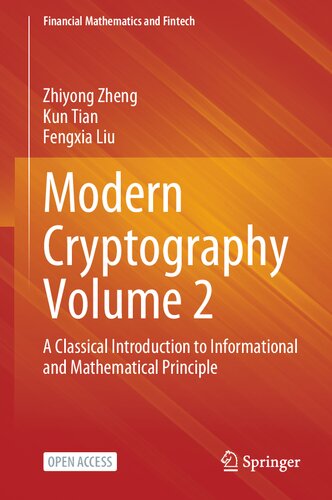
Modern Cryptography Volume 2: A Classical Introduction To Informational And Mathematical Principle
2023 · PDF

MySQL® Notes for Professionals book
2018 · PDF

MrExcel 2022: Boosting Excel
2022 · PDF

MrExcel 2022: Boosting Excel
2022 · PDF