Plautus, Vol. II: Casina. The Casket Comedy. Curculio. Epidicus. The Two Menaechmuses
Book information
Description
Plautus (Titus Maccius), born about 254 BCE at Sarsina in Umbria, went to Rome, engaged in work connected with the stage, lost his money in commerce, then turned to writing comedies. Twenty-one plays by Plautus have survived (one is incomplete). The basis of all is a free translation from comedies by such writers as Menander, Diphilus, and Philemon. So we have Greek manners of Athens about 300–250 BCE transferred to the Roman stage of about 225–185, with Greek places, people, and customs, for popular amusement in a Latin city whose own culture was not yet developed and whose manners were more severe. To make his plays live for his audience, Plautus included many Roman details, especially concerning slavery, military affairs, and law, with some invention of his own, notably in management of metres. The resulting mixture is lively, genial and humorous, with good dialogue and vivid style. There are plays of intrigue (Two Bacchises, The Haunted House, Pseudolus); of intrigue with a recognition theme (The Captives, The Carthaginian, Curculio); plays which develop character (The Pot of Gold, Miles Gloriosus); others which turn on mistaken identity (accidental as in the Menaechmi; caused on purpose as in Amphitryon); plays of domestic life (The Merchant, Casina, both unpleasant; Trinummus, Stichus, both pleasant). The Loeb Classical Library edition of Plautus is in five volumes.
Similar books
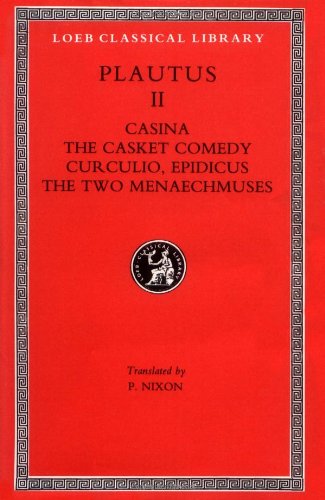
Plautus, Vol. II (Casina. The Casket Comedy. Curculio. Epidicus. The Two Menaechmuses)
1917 · PDF

Plautus, Vol. IV: The Little Carthaginian. Pseudolus. The Rope
1980 · PDF

Plautus: Stichus. Three Bob Day (Trinummus). Truculentus. The Tale of a Travelling Bag (Vidularia). Fragments
1952 · PDF

MySQL® Notes for Professionals book
2018 · PDF

MrExcel 2022: Boosting Excel
2022 · PDF

MrExcel 2022: Boosting Excel
2022 · PDF

Session C11: Ancient Cultural Landscapes in South Europe – their Ecological Setting and Evolution, Session C22: Gardeners from South America, Session S04: Agro-Pastoralism and Early Metallurgy Sessions, Session WS29: The Idea of Enclosure in Recent Iberian Prehistory, Session C88: Rhytmes et causalites des dynamiques de l'anthropisation en Europe entre 6500 ET 500 BC: Hypotheses socio-culturelles et/ou climatiques: Proceedings of the XV UISPP World Congress (Lisbon 4-9 September 2006) / Actes du XV Congrès Mondial (Lisbonne 4-9 Septembre 2006) Vol.36
2010 · PDF

THE BRITISH ARMY IN INDIA: ITS PRESERVATION BY AN APPROPRIATE CLOTHING, HOUSING, LOCATING, RECREATIVE EMPLOYMENT, AND HOPEFUL ENCOURAGEMENT OF THE TROOPS. with AN APPENDIX ON INDIA : THE CLIMATE OP ITS HILLS ; THE DEVELOPMENT OF ITS RESODRCBS, INDUSTRY, AND ARTS ; THE ADMINISTRATION OF JUSTICE ; THE BLACK ACT ; THE PROGRESS OF CHRISTIANITY ; THE TRAFFIC IN OPIUM ; THE VALUE OF INDIA ; PERMANENT CAUSES OF DISAFFECTION, AND OF THE RECENT REBELLION ; THE TRADITIONARY POLICY; MISGOVERNMENT BY NATIVE RULERS ; ANNEXATIONS OF THEIR TERRITORY, ETC.
1858 · PDF