Arbitrage theory in continuous time
Book information
Description
Cover Arbitrage Theory in Continuous Time: Fourth edition Copyright Dedication PREFACE TO THE FOURTH EDITION PREFACE TO THE FIRST EDITION ACKNOWLEDGEMENTS CONTENTS 1: INTRODUCTION 1.1 Problem Formulation PART I: DISCRETE TIME MODELS 2: THE BINOMIAL MODEL 2.1 The One Period Model 2.1.1 Model Description 2.1.2 Portfolios and Arbitrage 2.1.3 Contingent Claims 2.1.4 Risk Neutral Valuation 2.2 The Multiperiod Model 2.2.1 Portfolios and Arbitrage 2.2.2 Contingent Claims 2.3 Exercises 2.4 Notes 3: A MORE GENERAL ONE PERIOD MODEL 3.1 The Model 3.2 Absence of Arbitrage 3.3 Martingale Measures 3.4 Martingale Pricing 3.5 Completeness 3.6 Stochastic Discount Factors 3.7 Exercises PART II: STOCHASTIC CALCULUS 4: STOCHASTIC INTEGRALS 4.1 Introduction 4.1.1 The Wiener Process 4.2 Information 4.3 Stochastic Integrals 4.4 Martingales 4.5 Stochastic Calculus and the Itˆo Formula 4.6 Examples 4.7 The Multidimensional Itˆo Formula 4.8 Correlated Wiener Processes 4.9 Exercises 4.10 Notes 5: STOCHASTIC DIFFERENTIAL EQUATIONS 5.1 Stochastic Differential Equations 5.2 Geometric Brownian Motion 5.3 The Linear SDE 5.4 The Infinitesimal Operator 5.5 Partial Differential Equations 5.6 The Kolmogorov Equations 5.7 Exercises 5.8 Notes PART III: ARBITRAGE THEORY 6: PORTFOLIO DYNAMICS 6.1 Introduction 6.2 Self-financing Portfolios in Discrete Time 6.2.1 Basic Definitions 6.2.2 Self-financing Portfolios 6.2.3 The Cumulative Dividend Process 6.3 Self-financing Portfolios in Continuous Time 6.4 Portfolio Weights 7: ARBITRAGE PRICING 7.1 Introduction 7.2 More on the Bank Account 7.3 Contingent Claims and Arbitrage 7.4 The Black–Scholes Equation 7.5 Risk Neutral Valuation 7.6 The Black–Scholes Formula 7.7 Forward and Futures Contracts 7.7.1 Forward Contracts 7.7.2 Futures Contracts and the Black Formula 7.8 Volatility 7.8.1 Historic Volatility 7.8.2 Implied Volatility 7.9 American Options 7.10 Exercises 7.11 Notes 8: COMPLETENESS AND HEDGING 8.1 Introduction 8.2 Completeness in the Black–Scholes Model 8.3 Completeness—Absence of Arbitrage 8.4 Exercises 8.5 Notes 9: A PRIMER ON INCOMPLETE MARKETS 9.1 Introduction 9.2 A Scalar Non-priced Underlying Asset 9.3 Summing Up 9.4 Exercises 9.5 Notes 10: PARITY RELATIONS AND DELTA HEDGING 10.1 Parity Relations 10.2 The Greeks 10.3 Delta and Gamma Hedging 10.4 Exercises 11: THE MARTINGALE APPROACH TO ARBITRAGE THEORY 11.1 The Case of Zero Interest Rate 11.2 Absence of Arbitrage and Martingale Measures 11.3 A Rough Sketch of the Proof 11.3.1 Existence of an EMM Implies Absence of Arbitrage 11.3.2 Absence of Arbitrage Implies Existence of an EMM 11.4 The General Case 11.5 Completeness 11.6 Pricing Contingent Claims 11.7 Pricing by Replication 11.8 Stochastic Discount Factors 11.9 Summary for the Working Economist 11.10 Notes 12: THE MATHEMATICS OF THE MARTINGALE APPROACH 12.1 Stochastic Integral Representations 12.2 The Girsanov Theorem: Heuristics 12.3 The Girsanov Theorem 12.4 The Converse of the Girsanov Theorem 12.5 Girsanov Transformations and Stochastic Differentials 12.6 Maximum Likelihood Estimation 12.7 Exercises 12.8 Notes 13: BLACK–SCHOLES FROM A MARTINGALE POINT OF VIEW 13.1 Absence of Arbitrage 13.2 Pricing 13.3 Completeness 14: MULTIDIMENSIONAL MODELS: MARTINGALE APPROACH 14.1 Absence of Arbitrage 14.2 Completeness 14.3 Hedging 14.4 Pricing 14.5 Markovian Models and PDEs 14.6 Market Prices of Risk 14.7 The Stochastic Discount Factor 14.8 The Hansen–Jagannathan Bounds 14.9 Exercises 14.10 Notes 15: CHANGE OF NUMERAIRE 15.1 Introduction 15.2 Generalities 15.3 Changing the Numeraire 15.4 Some Examples 15.5 Forward Measures 15.5.1 Using the T-bond as Numeraire 15.6 A General Option Pricing Formula 15.6.1 General Theory 15.6.2 The Case of Deterministic Volatility 15.7 The Numeraire Portfolio 15.7.1 General Theory 15.7.2 The Objective Measure P as a Martingale Measure 15.8 Exercises 15.9 Notes 16: DIVIDENDS 16.1 Discrete Dividends 16.1.1 Dividend Structure 16.1.2 The Price Structure 16.1.3 A Black–Scholes Model with a Discrete Dividend 16.1.4 Option Pricing 16.1.5 Risk Neutral Valuation 16.1.6 An Example 16.2 Continuous Dividends I: Classical Methods 16.2.1 Continuous Dividend Yield 16.3 Continuous Dividends II: Martingale Methods 16.3.1 The Bank Account as Numeraire 16.3.2 Continuous Dividend Yield Revisited 16.3.3 An Arbitrary Numeraire 16.4 Exercises 17: FORWARD AND FUTURES CONTRACTS 17.1 Forward Contracts 17.2 Futures Contracts 17.3 Futures Options and Black-76 17.3.1 Generalities 17.3.2 The Black-76 Formula 17.4 Exercises 17.5 Notes 18: CURRENCY DERIVATIVES 18.1 Pure Currency Contracts 18.2 The Martingale Approach 18.3 Domestic and Foreign Equity Markets 18.4 An Extended Black–Scholes Model 18.5 The Siegel Paradox 18.6 Exercises 18.7 Notes 19: BONDS AND INTEREST RATES 19.1 Zero Coupon Bonds 19.2 Interest Rates 19.2.1 Definitions 19.2.2 Relations between df (t,T), dp(t,T), and dr(t) 19.2.3 An Expectation Hypothesis 19.2.4 An Alternative View of the Money Account 19.3 Coupon Bonds, Swaps, and Yields 19.3.1 Fixed Coupon Bonds 19.3.2 Floating Rate Bonds 19.3.3 Interest Rate Swaps 19.3.4 Yield and Duration 19.4 Exercises 19.5 Notes 20: SHORT RATE MODELS 20.1 Generalities 20.2 The Term Structure Equation 20.3 Martingale Analysis 20.4 Exercises 20.5 Notes 21: MARTINGALE MODELS FOR THE SHORT RATE 21.1 Q-Dynamics 21.2 Properties of the Short Rate Models 21.2.1 Models with Linear Dynamics 21.2.2 Models with Mean Reversion 21.2.3 Lognormal Models 21.2.4 Square Root Models 21.3 Inversion of the Yield Curve 21.4 Affine Term Structures 21.4.1 Definition and Existence 21.5 Analytical Results for Some Standard Models 21.5.1 The Vasiˇcek Model 21.5.2 The Ho–Lee Model 21.5.3 The CIR Model 21.5.4 The Hull–White Model 21.6 Bond Options in the Hull–White Model 21.7 Exercises 21.8 Notes 22: FORWARD RATE MODELS 22.1 The Heath–Jarrow–Morton Framework 22.2 Martingale Modeling 22.3 The General Gaussian Model 22.4 The Musiela Parameterization 22.5 Exercises 22.6 Notes 23: LIBOR MARKET MODELS 23.1 Caps: Definition and Market Practice 23.2 The LIBOR Market Model 23.3 Pricing Caps in the LIBOR Model 23.4 Terminal Measure Dynamics and Existence 23.5 Calibration and Simulation 23.6 The Discrete Savings Account 23.7 Notes 24: POTENTIALS AND POSITIVE INTEREST 24.1 Generalities 24.2 The Flesaker–Hughston Framework 24.3 Changing Base Measure 24.4 Decomposition of a Potential 24.5 The Markov Potential Approach of Rogers 24.6 Exercises 24.7 Notes PART IV: OPTIMAL CONTROL AND INVESTMENT THEORY 25: STOCHASTIC OPTIMAL CONTROL 25.1 An Example 25.2 The Formal Problem 25.3 Embedding the Problem 25.4 Time Consistency and the Bellman Principle 25.5 Deriving the Hamilton–Jacobi–Bellman Equation 25.6 Handling the HJB Equation 25.7 The Linear Regulator 25.8 Exercises 25.9 Notes 26: OPTIMAL CONSUMPTION AND INVESTMENT 26.1 A Generalization 26.2 Optimal Consumption and Investment 26.3 The Mutual Fund Theorems 26.3.1 The Case with No Risk Free Asset 26.3.2 The Case with a Risk Free Asset 26.4 Exercises 26.5 Notes 27: THE MARTINGALE APPROACH TO OPTIMAL INVESTMENT 27.1 Generalities 27.2 The Basic Idea 27.3 The Optimal Terminal Wealth 27.4 The Optimal Wealth Process 27.5 The Optimal Portfolio 27.6 Log Utility 27.6.2 The Optimal Wealth Process 27.6.3 The Optimal Portfolio 27.7 Other Utility Functions 27.8 Optimal Consumption Problems 27.9 Exercises 27.10 Notes 28: OPTIMAL STOPPING THEORY AND AMERICAN OPTIONS 28.1 Introduction 28.2 Generalities 28.3 Some Simple Results 28.4 Discrete Time 28.4.1 The General Case 28.4.2 Markovian Models 28.4.3 Infinite Horizon 28.5 Continuous Time 28.5.1 General Theory 28.5.2 Diffusion Models 28.6 American Options 28.6.1 The American Call without Dividends 28.6.2 The American Put Option 28.6.3 The Perpetual American Put 28.7 Exercises 28.8 Notes PART V: INCOMPLETE MARKETS 29: INCOMPLETE MARKETS 29.1 Introduction 29.2 A Markov Factor Model 29.3 The Independent Factor Markov Model 29.3.1 Absence of Arbitrage 29.3.2 Incompleteness 29.4 Methods to Handle Market Incompleteness 29.5 Notes 30: THE ESSCHER TRANSFORM AND THE MINIMAL MARTINGALE MEASURE 30.1 The Esscher Transform 30.1.1 The Standard Esscher Transform 30.1.2 The Generalized Esscher Transform 30.1.3 The Markov Factor Model 30.1.4 The Independent Factor Markov Model 30.2 The Minimal Martingale Measure 30.2.1 Definition and Existence 30.2.2 Basic Properties of QM 30.2.3 Economic Interpretation of QM 30.3 Notes 31: MINIMIZING f-DIVERGENCE 31.1 Definition and Basic Properties 31.2 Minimal Reverse Entropy 31.3 Minimal Entropy in a Factor Model 31.4 Duality 31.4.1 Utility Maximization of Financial Derivatives 31.4.2 Minimax Measures 31.4.3 Log Utility 31.4.4 Exponential Utility 31.5 Notes 32: PORTFOLIO OPTIMIZATION IN INCOMPLETE MARKETS 32.1 Setup 32.2 The Complete Market Case 32.3 Incomplete Market, Finite Ω 32.4 Incomplete Market, General Ω 32.5 Notes 33: UTILITY INDIFFERENCE PRICING AND OTHER TOPICS 33.1 Global Indifference Pricing 33.2 Marginal Indifference Pricing 33.3 Hedging 33.4 Notes 34: GOOD DEAL BOUNDS 34.1 General Ideas 34.2 The Model 34.3 The Good Deal Bounds 34.4 The Embedded Optimization Problem 34.5 Relations to the Minimal Martingale Measure 34.6 An Option with Basis Risk 34.7 Notes PART VI: DYNAMIC EQUILIBRIUM THEORY 35: EQUILIBRIUM THEORY: A SIMPLE PRODUCTION MODEL 35.1 The Model 35.2 Equilibrium 35.3 Introducing a Central Planner 35.4 Exercises 35.5 Notes 36: THE COX–INGERSOLL–ROSS FACTOR MODEL 36.1 The Model 36.1.1 Exogenous Objects 36.1.2 Endogenous Objects 36.1.3 Economic Agents 36.2 The Portfolio Problem 36.2.1 Portfolio Dynamics 36.2.2 The Control Problem and the HJB Equation 36.3 Equilibrium 36.4 The Short Rate and the Risk Premium for F 36.5 The Equilibrium Stochastic Discount Factor 36.6 Risk Neutral Valuation 36.7 Introducing a Central Planner 36.8 Exercises 36.9 Notes 37: THE COX–INGERSOLL–ROSS INTEREST RATE MODEL 37.1 Exercises 37.2 Notes 38: ENDOWMENT EQUILIBRIUM: UNIT NET SUPPLY 38.1 The Model 38.1.1 Exogenous Objects 38.1.2 Endogenous Objects 38.2 The Martingale Approach 38.2.1 The Control Problem 38.2.2 Equilibrium 38.2.3 Log Utility 38.3 Extending the Model 38.3.1 The General Scalar Case 38.3.2 A Factor Model 38.4 Several Endowment Processes 38.5 Exercises 38.6 Notes Appendix A: MEASURE AND INTEGRATION A.1 Sets and Mappings A.2 Measures and Sigma-Algebras A.3 Integration A.4 Sigma-Algebras and Partitions A.5 Sets of Measure Zero A.6 The Lp Spaces A.7 Hilbert Spaces A.8 Sigma-Algebras and Generators A.9 Product Measures A.10 The Lebesgue Integral A.11 The Radon–Nikodym Theorem A.12 Exercises A.13 Notes Appendix B: PROBABILITY THEORY B.1 Random Variables and Processes B.2 Partitions and Information B.3 Sigma-Algebras and Information B.4 Independence B.5 Conditional Expectations B.6 Equivalent Probability Measures B.7 Exercises B.8 Notes Appendix C: MARTINGALES AND STOPPING TIMES C.1 Martingales C.2 Discrete Stochastic Integrals C.3 Likelihood Processes C.4 Stopping Times C.5 Exercises Appendix D: CONVEX DUALITY D.1 Conjugate Functions D.2 Lagrange Functions and Saddle Points D.3 An Envelope Theorem REFERENCES INDEX
Similar books
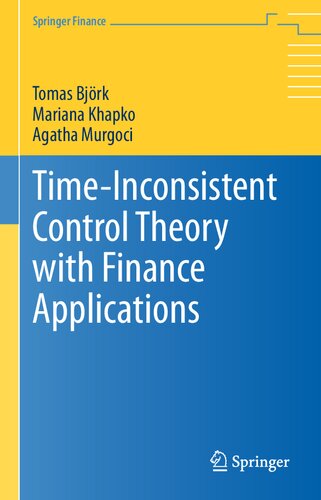
Time-Inconsistent Control Theory with Finance Applications
2021 · PDF

Time-Inconsistent Control Theory with Finance Applications
2021 · EPUB
Arbitrage Theory in Continuous Time
2020 · PDF

Arbitrage Theory in Continuous Time
1999 · PDF

Arbitrage Theory in Continuous Time (Oxford Finance)
2004 · PDF

Arbitrage Theory in Continuous Time (Oxford Finance)
2009 · PDF

Arbitrage Theory in Continuous Time
2004 · PDF

Arbitrage Theory in Continuous Time
1999 · PDF