Defending the West: A Critique of Edward Said's Orientalism
Book information
Description
This is the first systematic critique of Edward Said's influential work, "Orientalism", a book that for almost three decades has received wide acclaim, voluminous commentary, and translation into more than fifteen languages. Said's main thesis was that the Western image of the East was heavily biased by colonialist attitudes, racism, and more than two centuries of political exploitation. Although Said's critique was controversial, the impact of his ideas has been a pervasive rethinking of Western perceptions of Eastern cultures, plus a tendency to view all scholarship in Oriental Studies as tainted by considerations of power and prejudice. In this thorough reconsideration of Said's famous work, Ibn Warraq argues that Said's case against the West is seriously flawed. Warraq accuses Said of not only wilfully misinterpreting the work of many scholars, but also of systematically misrepresenting Western civilization as a whole. With example after example, he shows that ever since the Greeks Western civilization has always had a strand in its very makeup that has accepted non-Westerners with open arms and has ever been open to foreign ideas. The author also criticizes Said for inadequate methodology, incoherent arguments, and a faulty historical understanding. He points out, not only Said's tendentious interpretations, but historical howlers that would make a sophomore blush. Warraq further looks at the destructive influence of Said's study on the history of Western painting, especially of the 19th century, and shows how, once again, the epigones of Said have succeeded in relegating thousands of first-class paintings to the lofts and storage rooms of major museums. An extended appendix reconsiders the value of 18th- and 19th-century Orientalist scholars and artists, whose work fell into disrepute as a result of Said's work.
Similar books

Sir Walter Scott's Crusades and Other Fantasies
2013 · EPUB

What the Koran Really Says: Language, Text, and Commentary
2010 · MOBI
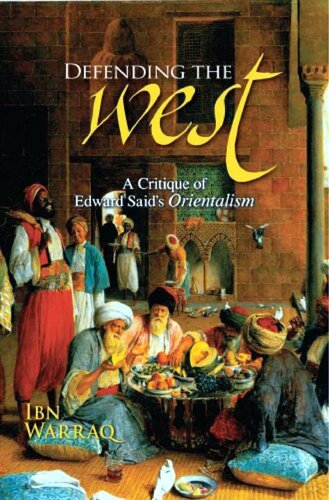
Defending the West: A Critique of Edward Said's Orientalism
2010 · MOBI

What the Koran Really Says: Language, Text, and Commentary
2010 · EPUB

Defending the West: A Critique of Edward Said's Orientalism
2010 · EPUB

Por qué no soy musulmán
FB2

The Islam in Islamic Terrorism: The Importance of Beliefs, Ideas, and Ideology
2017 · AZW3

The Islam in Islamic Terrorism: The Importance of Beliefs, Ideas, and Ideology
2017 · EPUB