Dominant Algorithms to Evaluate Artificial Intelligence: From the view of Throughput Model
Book information
Description
This book describes the Throughput Model methodology that can enable individuals and organizations to better identify, understand, and use algorithms to solve daily problems. The Throughput Model is a progressive model intended to advance the artificial intelligence (AI) field since it represents symbol manipulation in six algorithmic pathways that are theorized to mimic the essential pillars of human cognition, namely, perception, information, judgment, and decision choice. The six AI algorithmic pathways are (1) Expedient Algorithmic Pathway, (2) Ruling Algorithmic Guide Pathway, (3) Analytical Algorithmic Pathway, (4) Revisionist Algorithmic Pathway, (5) Value Driven Algorithmic Pathway, and (6) Global Perspective Algorithmic Pathway. As AI is increasingly employed for applications where decisions require explanations, the Throughput Model offers business professionals the means to look under the hood of AI and comprehend how those decisions are attained by organizations. Key Features: - Covers general concepts of Artificial intelligence and machine learning - Explains the importance of dominant AI algorithms for business and AI research - Provides information about 6 unique algorithmic pathways in the Throughput Model - Provides information to create a roadmap towards building architectures that combine the strengths of the symbolic approaches for analyzing big data - Explains how to understand the functions of an AI algorithm to solve problems and make good decisions - informs managers who are interested in employing ethical and trustworthiness features in systems. Dominant Algorithms to Evaluate Artificial Intelligence: From the view of Throughput Model is an informative reference for all professionals and scholars who are working on AI projects to solve a range of business and technical problems. Cover Title Copyright End User License Agreement Contents Preface Acknowledgements Introduction to Artificial Intelligence and Algorithms INTRODUCTION AI SUB AREAS: NATURAL LANGUAGE PROCESSING, MACHINE LEARNING AND DEEP LEARNING AI ALGORITHMS IMPACT ON SOCIETY THE ROOTS OF MACHINE LEARNING BIAS PROPERTIES OF ALGORITHMS THROUGHPUT MODEL FUTURE AI OPPORTUNITIES FOR SOCIETY Financial Robots Where are we headed? CONCLUSION REFERENCES Understanding Throughput Decision-making Modeling INTRODUCTION APPLICATION OF THROUGHPUT MODELS-CREATING A TRUSTED ENVIRONMENT USING ALGORITHM PATHS Stochastic Learning FOUR FORMS OF AI Reactive Machines Limited Memory Theory of Mind Self-awareness INTRODUCTION OF THE THROUGHPUT MODEL PARALLEL PROCESSING DIMENSIONS OF THE THROUGHPUT MODEL Types of Parallelism: IoT and Cloud Computing Comparison of Internet of Things and Cloud Computing Pairing with Edge Computing Leading to Quantum Computing CONCLUSION Is there a Need for Throughput Modeling to Represent Symbolic AI and Neural Networks? REFERENCES Six Dominant Decision-making Algorithms INTRODUCTION HUMAN-COMPUTER INTERACTION (HCI) AND DECISION-MAKING Future of Human Computer Interaction (HCI) Applications and Services Pertaining to HCI Includes: ONWARDS TO THE USE OF ALGORITHMS Other Algorithmic Patterns Broader Design Algorithms and Decision-Making Processes THROUGHPUT MODELLING SIX DOMINANT ALGORITHMS The Process of Perception Six Dominant Decision-Making Algorithms ADVANTAGES AND DISADVANTAGES OF THE USE OF AI ALGORITHMS CONCLUSION REFERENCES The Expedient Algorithmic Pathway INTRODUCTION BIOMETRICS INFUSED WITH AI TECHNOLOGY EXAMPLE 1: EXPEDIENT ALGORITHMIC PATHWAY APPLIED TO STABLE AND UNSTABLE ENVIRONMENTS Example 2: Expedient Algorithmic Pathway applied Vault Doors CONCLUSION REFERENCES The Ruling Guide Algorithmic Pathway INTRODUCTION Human Rights Contracts and Liability Data Privacy Intellectual Property EXAMPLE 1 –RULING GUIDE ALGORITHMIC PATHWAY Machine Learning Deep Learning Biometric Technology Recognition: Identification vs. Verification THROUGHPUT MODELING ALGORITHMS AND FRAUD PREVENTION Biometric Technologies: Physiological vs. Behavioral Fraud and Biometrics Decision Tree and Biometrics Type 1 and 2 Errors EXAMPLE 2 –RULING GUIDE ALGORITHMIC PATHWAY Can Blockchain Augment XBRL AI Generated Solutions for Fitness Training CONCLUSION REFERENCES The Analytical Algorithmic Pathway INTRODUCTION EXAMPLE 6.1 -- ANALYTICAL PATHWAY (I→J→D) Company Profile Internal Controls System Biometrics EXAMPLE 6.1 -- ANALYTICAL PATHWAY (I→J→D) EMPLOYED IN ELANDA COMPANY Background and Organization for Elanda Inc., Pharmaceutical Business Biometric Internal Control Needs Fraud Analysis Inventory and Purchasing Cycle Misrepresentation of Inventory and Falsification of Documents Vendor Selection Safeguard of Drugs and Chemical Components and Theft of Inventory Benefits of Biometrics Awareness of Bill of Rights CONCLUSION Classification of Recommended Biometrics REFERENCES The Revisionist Algorithmic Pathway INTRODUCTION EXAMPLE 1: REVISIONIST PATHWAY (I→P→D) FOR PAY CARD SYSTEMS Machine Learning Implemented with the Revisionist Pathway (I→P→D) Supervised Learning Unsupervised Learning Deep Learning Application for Accountants, Auditors and Forensic Accountants Biometrics Enhancing the Revisionist Algorithmic Pathway Fraud and Artificial Intelligence Decision Trees Type 1 and Type 2 Errors Pay Card Access System EXAMPLE 2: REVISIONIST PATHWAY (I→P→D) AI Technologies Employed in Airports Deep Learning Big Data in Relationship to the Throughput Model Algorithms The Relationship of Biometrics and Fraud Reservation Check-in Checkpoint Screening CONCLUSION REFERENCES The Value-driven Algorithmic Pathway INTRODUCTION DECISION TREES Different Kinds of Decision Tree Models Prediction of Continuous Variables Prediction of Categorical Variables Entropy Information Gain Leaf Node Root Node How Decision Trees in AI Are Developed EXAMPLE 1: THE VALUE-DRIVEN ALGORITHMIC PATHWAY APPLIED TO HEALTHCARE SYSTEMS MACRA and its Correlation with AI EXAMPLE 2: THE VALUE-DRIVEN ALGORITHMIC PATHWAY APPLIED TO WAREHOUSE SECURITY SYSTEMS Background Algorithms Biometrics Machine Learning Deep Learning Decision Tree Applied to the Warehouse Positives: Negatives: Positives: Negatives: Type I and Type II Errors Aadhaar Use of Biometrics CONCLUSION REFERENCES The Global Perspective Algorithmic Pathway INTRODUCTION EXAMPLE 1: GLOBAL PERSPECTIVE ALGORITHMIC PATHWAY EXAMPLE 2: GLOBAL PERSPECTIVE ALGORITHMIC PATHWAY DECREASING FRAUD SOURCE: PARTIALLY ADAPTED BY: RODGERS, AL FAYI, AL-REFIAY, MURRAY [8]. CONCLUSION REFERENCES Moving Forward with Throughput Modelling and Advancing Technologies INTRODUCTION 3. 5G Technology 4. Internet of Things (IoT) 5. Enhancing augmented reality (AR), virtual reality (VR), and mixed reality (MR) 6. Cyber Security 7. DARQ Technology 8. As-a-Service 9. IoB 10. Human Enhancement (HE) 11. Automation and Robotics CONCLUSION REFERENCES The Coming Era of Artificial Intelligence willProvide Prosperity and Peace INTRODUCTION THROUGHPUT MODELLING AI BASED BIOMETRICS TECHNOLOGY AND THE FRAUD TRIANGLE ARTIFICIAL INTELLIGENCE RE-SHAPING THE WORLD THROUGHPUT MODELING AND ALGORITHMS THE ROLE OF CLOUD COMPUTING ON THE INTERNET OF THINGS CONCLUSION REFERENCES Subject Index Back Cover
Similar books

E-Commerce Issues Addressed in a Throughput Model
2010 · PDF

Dominant Algorithms to Evaluate Artificial Intelligence: From the view of Throughput Model
2022 · EPUB

Dominant Algorithms to Evaluate Artificial Intelligence: From the view of Throughput Model
2022 · RAR

Artificial Intelligence in a Throughput Model: Some Major Algorithms
2020 · PDF
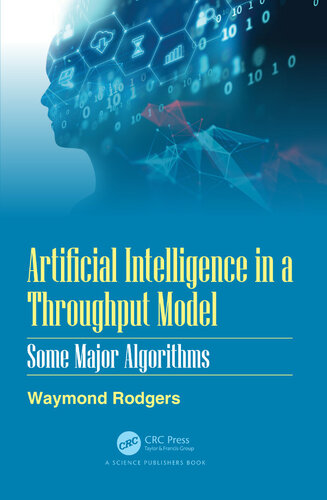
Artificial Intelligence in a Throughput Model: Some Major Algorithms
2020 · EPUB

Decision Making for Personal Investment: Real Estate Financing, Foreclosures and Other Issues
2017 · PDF

MySQL® Notes for Professionals book
2018 · PDF

MrExcel 2022: Boosting Excel
2022 · PDF