Resource Scarcity in Austere Environments: An Ethical Examination of Triage and Medical Rules of Eligibility
Book information
Description
This book focuses on resource allocation in military and humanitarian medicine during times of scarcity and austerity. It is in these times that health systems bend, break, and even collapse and where resource allocation becomes a paramount concern and directly impacts clinical decision-making. Such times are challenging and this book covers this very important, yet, scarcely researched topic within the field of bioethics. This work brings together experts and practitioners in the fields of military health care, philosophy, ethics, and other disciplines to provide analysis on a variety of related topics ranging from case studies and first-hand experiences to policy and philosophical analysis. It is of great interest to to academics, practitioners, policy makers and students who are looking for analyses and guidance regarding the fair provision of medical care and the use of medical rules of eligibility under adverse conditions. Contents Editors and Contributors About the Editors Contributors Acronyms and Abbreviations Chapter 1: Introduction and Synopsis 1.1 Introduction 1.2 Disaster & Crisis Focused Interventions: A Spectrum of Activities United by Scarcity 1.3 Humanitarian & Military Actors: Differing Goals & Intention 1.4 Origin and Definition of Triage 1.4.1 Triage Categories 1.5 Outline & Synopsis 1.5.1 Section I 1.5.1.1 ‘Gate-Keeping Access to Deployed Military Health Services’ – Perspectives of Military Medical Leaders—Bricknell and Kowitz 1.5.1.2 Reconsidering Triage: Medical, Ethical and Historical Perspectives on Planning for Mass Casualty Events in Military and Civilian Settings—Horn, James, Draper, and Mayhew 1.5.1.3 Medical Rules of Eligibility: A Comparative Analysis—Clifford, Eagan, and Eagan 1.5.1.4 Ethical and Legal Basis for the Standards of Triage Used in the Russian Military Medical Service—Kholikov 1.5.2 Section II 1.5.2.1 The Phenomenon of Allocation. Military Pathways in the Light of Biomedical Ethical Principles—Fischer 1.5.2.2 Battlefield Triage and Resource Allocation During a Pandemic: What Can We Learn from the Past and How Must We Adapt for the Future?—Krick, Hogue, Studer, Reese, and Weiss 1.5.2.3 Medical Triage by Moral Responsibility—Woodside 1.5.2.4 Medical Rules of Eligibility – Can Preferential Medical Treatment Provisions Be Ethically Justified?—Messelken 1.5.2.5 Fairness in Military Care: Might a Hybrid Concept of Equity Be the Answer? —Gilbert, Stevens, and Hurst 1.5.2.6 Cicero and the Problem of Triage. Why There Is No Moral Algorithm in Distributing Scarce Resources—Koch 1.5.2.7 Facing Death: An Ethical Exploration of Thanatophobia in Combat Casualty Care—Jeschke, Martinez, Choi, Dorsch, and Huffman References Chapter 2: ‘Gate-Keeping Access to Deployed Military Health Services’ – Perspectives of Military Medical Leaders 2.1 Introduction 2.2 Scenario – Case Example 2.3 Legal, Ethical and Clinical Principles 2.4 Policies for Entitlement to Care 2.5 Military Medical Planning 2.6 Medical Rules of Eligibility 2.7 Triage 2.8 Review of the Scenario Questions 2.9 Training of Medical Personnel 2.10 Conclusions References Chapter 3: Reconsidering Triage: Medical, Ethical and Historical Perspectives on Planning for Mass Casualty Events in Military and Civilian Settings 3.1 Introduction 3.1.1 Why MASCAL Management Needs to Be Rethought 3.2 Case Study 1 – The NHS 3.2.1 Evidence from the UK National Health Service That Normal Standards Cannot Be Maintained in Times of Extreme Pressure 3.2.2 NHS Adaptations to Extreme Pressure (Analogous to a MASCAL Incident) 3.2.2.1 From ‘Triage for Priority’ to Flow 3.2.2.2 Strategies to Maximise Flow: Diversion/Remote Monitoring 3.3 Case Study 2 – Historical Considerations: Mass Casualty Management on the Western Front of the Great War (1915–1918) 3.3.1 Lowest Capable Provider 3.3.2 Context Specific Excellence: The ‘Best Care Feasible’ Vs ‘Gold Standard Care’ 3.3.3 Focussing on Quality End of Life Care 3.4 Some Ethical Considerations 3.5 Summary References Chapter 4: Medical Rules of Eligibility: A Comparative Analysis 4.1 Introduction 4.2 An Overview of NATO Doctrine 4.2.1 An Overview of NATO Medical Doctrine 4.2.2 Developing NATO Medical Rules of Eligibility 4.3 A Review of Canadian Armed Forces (CAF) Medical Doctrine 4.3.1 Health Services Planning 4.3.2 Developing CAF Medical Rules of Eligibility 4.4 A Review of the United States Department of Defense (DoD) Doctrine 4.4.1 Joint Services Doctrine 4.4.2 A Review of U.S. Army Medical Doctrine 4.4.3 U.S. Doctrine – Conclusion 4.5 Key Similarities Between NATO, CAF, and US DoD Medical Doctrine 4.5.1 Key Differences Between NATO, CAF, and U.S. DoD Medical Doctrine 4.6 Conclusion References Chapter 5: Ethical and Legal Basis for the Standards of Triage Used in the Russian Military Medical Service 5.1 Conclusion References Chapter 6: The Phenomenon of Allocation: Military Pathways in the Light of Biomedical Ethical Principles 6.1 Introduction 6.2 Terminological Aspects 6.3 Allocation, Allocational Problems and Tragic Choices 6.4 Implicit vs. Explicit Allocation 6.5 Triage 6.6 Allocational Problems in the Context of War 6.7 Allocation and Bioethical Principles 6.8 The Physician-Patient-Relationship 6.9 Conclusion References Chapter 7: Applying Battlefield Triage Ethics and Resource Allocation to a Contemporary Public Health Crisis: Lessons Learned from the Past and Adapting Them for the Future 7.1 Introduction 7.2 Ethical Foundations 7.3 Ethical Priorities on the Battlefield 7.4 Public Health Ethics and Triage 7.5 Lessons from the Battlefield 7.6 Conclusion References Chapter 8: Medical Triage by Moral Responsibility in Crisis and War 8.1 Introduction 8.2 Some Assumptions 8.3 Impartiality 8.3.1 Endorsements of Impartiality 8.3.2 Against Impartiality 8.4 TMR, Liability, and the Just Distribution of Harm 8.4.1 Moral Liability to Defensive Killing 8.4.2 LRSs and Liability to Allowed Harm 8.5 Some Objections and Replies 8.6 TMR, COVID-19, and Vaccination 8.6.1 The Moral Right to Refuse Vaccination 8.6.2 Vaccination Priority 8.7 TMR and the Medical Ethics of War 8.8 Conclusion References Chapter 9: Medical Rules of Eligibility – Can Preferential Medical Treatment Provisions Be Ethically Justified? 9.1 Introduction 9.1.1 A Cursory Look at IHL – Legal Framework during Armed Conflict 9.2 Medical Rules of Eligibility – Macro-Triage in the Military 9.2.1 Military Trauma Care 9.2.2 Example of Applying MROE 9.3 Can Medical Rules of Eligibility Be Morally Justified? 9.3.1 Pro – Why Preferential Medical Treatment for Own Soldiers Is Legitimate 9.3.1.1 “Military Necessity” or Military Triage Reasoning 9.3.1.2 Fiduciary Obligation to Win Wars 9.3.1.3 Associative Duties 9.3.1.4 Missing Reciprocity: The Other Side Does Not Provide HC or Does Not Respect HCP 9.3.1.5 Unjust Combatants Have No Claim to HC 9.3.1.6 MROE Are a Precondition for Military Interventions that, Overall, Still Bring a Better Outcome for the Local Population 9.3.1.7 Local Responsibility, Do Not Interfere with Local System 9.3.1.8 Avoid Moral Injury Among HCP 9.3.2 Contra – Why Preferential Medical Treatment Is Ethically Problematic 9.3.2.1 MROE Are Against the Principles of Humanity and Non-discrimination 9.3.2.2 MROE Lead to an Ineffective Use of Resources – Too Much Reserve Capacity 9.3.2.3 Responsibility at Least with Regard to Caring for Some Patients 9.3.2.4 Health Care as a Remainder of Peace 9.4 Conclusions References Chapter 10: Fairness in Military Care: Might a Hybrid Concept of Equity Be the Answer? 10.1 Introduction 10.2 Equity in Bedside Resource Allocation 10.3 Traditional Concepts Employed in the Debate 10.3.1 Egalitarianism 10.3.2 Prioritarianism 10.3.3 Desertism 10.3.4 Sufficientism 10.4 On Which Philosophical Ground Physicians Base Their Decision? 10.5 Exploring Hybrid Equity: Are Hybrid Concepts Robust Enough? 10.6 Conclusion References Chapter 11: Cicero and the Problem of Triage: Why There Is No Moral Algorithm in Distributing Scarce Resources 11.1 Introduction 11.2 Moral Inequality 11.2.1 A Simple/Simplified Case 11.2.2 Revisionist Just War Theory 11.2.3 Moral Blackmail 11.2.4 Consequentialism 11.2.5 Against Punishment 11.3 Cicero’s Concept of Different “Personae” 11.3.1 Perspective Agency 11.3.2 Four Roles 11.3.3 Institutional Protections and Its Limitations 11.3.4 Excursus: Ex-Ante- and Ex-Post-Triage 11.3.5 The Complexity of Roles with Military Medical Personnel 11.4 Conclusion References Chapter 12: Facing Death: An Ethical Exploration of Thanatophobia in Combat Casualty Care 12.1 Background 12.1.1 Conceptual Diagram of Death Aversion in Modern Military and Medical Cultures 12.1.2 Current Cultural Paradigm of Casualty Management 12.1.3 Terror Management Theory and Medical Decision Making 12.1.4 Emergent Themes – Challenges Relative to Death Aversion 12.1.5 Possible Ways Forward References
Similar books

Health Care in Contexts of Risk, Uncertainty, and Hybridity
2021 · PDF
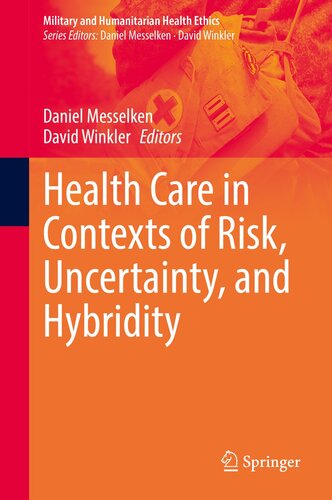
Health Care in Contexts of Risk, Uncertainty, and Hybridity
2021 · EPUB

MySQL® Notes for Professionals book
2018 · PDF

MrExcel 2022: Boosting Excel
2022 · PDF

MrExcel 2022: Boosting Excel
2022 · PDF

Session C11: Ancient Cultural Landscapes in South Europe – their Ecological Setting and Evolution, Session C22: Gardeners from South America, Session S04: Agro-Pastoralism and Early Metallurgy Sessions, Session WS29: The Idea of Enclosure in Recent Iberian Prehistory, Session C88: Rhytmes et causalites des dynamiques de l'anthropisation en Europe entre 6500 ET 500 BC: Hypotheses socio-culturelles et/ou climatiques: Proceedings of the XV UISPP World Congress (Lisbon 4-9 September 2006) / Actes du XV Congrès Mondial (Lisbonne 4-9 Septembre 2006) Vol.36
2010 · PDF

THE BRITISH ARMY IN INDIA: ITS PRESERVATION BY AN APPROPRIATE CLOTHING, HOUSING, LOCATING, RECREATIVE EMPLOYMENT, AND HOPEFUL ENCOURAGEMENT OF THE TROOPS. with AN APPENDIX ON INDIA : THE CLIMATE OP ITS HILLS ; THE DEVELOPMENT OF ITS RESODRCBS, INDUSTRY, AND ARTS ; THE ADMINISTRATION OF JUSTICE ; THE BLACK ACT ; THE PROGRESS OF CHRISTIANITY ; THE TRAFFIC IN OPIUM ; THE VALUE OF INDIA ; PERMANENT CAUSES OF DISAFFECTION, AND OF THE RECENT REBELLION ; THE TRADITIONARY POLICY; MISGOVERNMENT BY NATIVE RULERS ; ANNEXATIONS OF THEIR TERRITORY, ETC.
1858 · PDF

Idries Shah 27 Books Collection : A Perfumed Scorpion, A Veiled Gazelle, Caravan of Dreams, Darkest England, Destination Mecca, Evenings with Idries Shah, Knowing How to Know, Learning How to Learn, Letters and Lectures of Idries Shah, Neglected aspects of Sufi study, Observations, Oriental Magic, Reflections, Seeker after Truth, Special Illumination, Special Problems in the study of Sufi ideas, Sufi thought and action, Tales of the Dervishes, The Dermis Probe, The Elephant in the Dark, The Englishman Handbook, Idries Shah Antology, The Magic Monastery, The natives are restless, wisdom of the Idiots PDF.
2022 · PDF