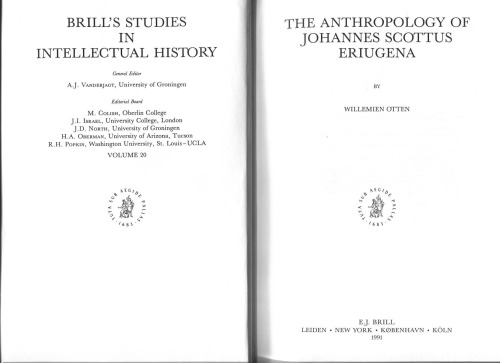
The Anthropology of Johannes Scottus Eriugena
Book information
Description
This book deals with Eriugena's anthropology in the general context of his thinking on universal nature. At the outset the role of man seems to be conditioned by nature's dynamic development through the Neoplatonic stages of procession and return. As man is located at the turning-point between procession and return, he is not only governed by nature's unfolding, but can also exercise control over it. Thus it is shown that man should be seen as much more independent than the cosmological structure of Eriugena's philosophy of nature seems to indicate. The study of Eriugena's anthropology urges a re-evaluation of the position of man in the early medieval period. Although man characteristically possesses a sinful, created state, Eriugena shows that this does not prevent him from entertaining a free and direct relationship with God and the surrounding universe. In dealing with the problem of human sin, Eriugena brings out Christ's saving role, but it seems counterbalanced by man's intrinsic potential as the "divine image" to rehabilitate himself. In this respect Eriugena's flexible method of reasoning - his handling of negative theology, theophany and allegorical exegesis - serves as a remarkable example of human independence in what has so often been portrayed as the "static" early-medieval world. PREFACE INTRODUCTION CHAPTER ONE. DIVISION, DEFINITION AND RETURN. AN INQUIRY INTO THE PROLOGUE OF THE PERIPHYSEON 1.1. The First Division of 'Natura': Division and Definition 1.2. The Second Division of 'Natura': Division and Return 1.3. The Relation Between the First and the Second Division. A Closing Comparison CHAPTER TWO. CREATION AND GOD. AN EXPLANATION OF MAJOR THEMES IN ERIUGENA'S THINKING Introduction A. Ontology and Intelligibility B. The Intermediary Role of Reason C. Summary 2.1.The Road from Creation to God. The Negative Approach A. Apophatte and Kataphatic Theology B. The Position of the Categories C. The Outcome of the Negative Approach: Success or Defeat 2.2. Transition to a New Set of Metaphors 2.3. The Road from God to Creation. The Metaphorical Approach A. Theophany B. Conclusions and Consequences CHAPTER THREE. FROM PHYSIOLOGY TO ANTHROPOLOGY 3.1. The Universe of Nature and its Dialectical Connotations A. Negative Theology versus Theophany B. The Theophanic Impact of Procession and Return C. Conclusion 3.2 Man's Position 'inside' and 'outside' the Universe A. 'Outside' the Universe B. 'Inside' the Universe C. Summary CHAPTER FOUR. THE UNIVERSE OF MAN: ITS PROCESSION AND RETURN Introduction A. The Dialectical Universe of Man B. Three Anthropological Levels 4.1. Man as Object of Natura Creata. An External Approach to Human Nature: 'Periphyseon' IV chs. 3 to 6, 11 to 15 A. The Position of Man B. Man and the Return of Nature C. Summary 4.2. Man as Imago Naturae - An Allegorical Approach to Human Nature: 'Periphyseon' IV, chs. 16 to 27 A. The Position of Man B. Man and the Return of Nature C. Summary 4.3. Man as the Reflective Subject of Nature: Knowledge, Self-Knowledge and Return. A Theophanic Approach to Human Nature: 'Periphyseon' IV, chs. 7 to iO85 A. The Position of Man B. The Return of Man CHAPTER FIVE. BACK TO GOD. THE FINAL 'REDITUS' OF MAN AND NATURE 5.1. The Three Anthropological Levels Interrelated 5.2. The Return of Nature through Man 5.3. The Final Return of Man: One with God LATIN APPENDIX REFERENCES INDEX OF NAMES
Similar books

Thinking Nature and the Nature of Thinking: From Eriugena to Emerson
2020 · PDF

Thinking Nature and the Nature of Thinking: From Eriugena to Emerson
2020 · PDF
The Anthropology of Johannes Scottus Eriugena
1991 · PDF

How the west was won: essays on the literary imagination, the canon, and the Christian middle ages for Burcht Pranger
2010 · PDF

Demons and the Devil in Ancient and Medieval Christianity (Supplements to Vigiliae Christianae - Texts and Studies of Early Christian Life and Language)
2011 · PDF
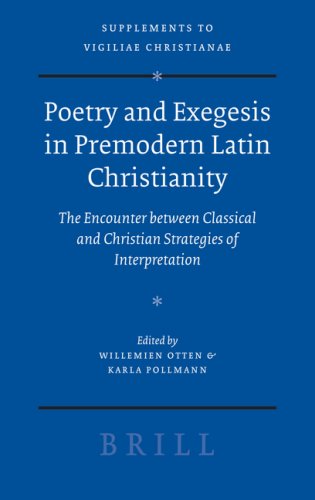
Poetry and Exegesis in Premodern Latin Christianity: The Encounter Between Classical and Christian Strategies of Interpretation (Supplements to Vigiliae ... of Early Christian Life and Language)
2007 · PDF

Poetry and Exegesis in Premodern Latin Christianity: The Encounter Between Classical and Christian Strategies of Interpretation
2007 · PDF

From Paradise to Paradigm: A Study of Twelfth-Century Humanism
2004 · PDF