History of Time: A Very Short Introduction
Book information
Description
Why do we measure time in the way that we do? Why is a week seven days long? At what point did minutes and seconds come into being? Why are some calendars lunar and some solar? The organization of time into hours, days, months, and years seems immutable and universal, but is actually far more artificial than most people realize. For example, the French Revolution resulted in a restructuring of the French calendar, and the Soviet Union experimented with five and then six-day weeks. Leofranc Holford-Strevens brings us this fascinating study of time using a range of examples from Ancient Rome and Julius Caesar's imposition of the Leap Year to the 1920's project for a fixed Easter. Those interested in time, history, and the development of the calendar will enjoy this absorbing exploration of an aspect of our lives that we all take for granted.
Similar books

The Disputatio Chori Et Praetextati: The Roman Calendar for Beginners (Studia Traditionis Theologiae) (English and Latin Edition) (Studia Traditionis ... in Early and Medieval Theology, 32)
2019 · PDF

Aulus Gellius: An Antonine Scholar and his Achievement
2003 · PDF

The Oxford Companion to the Year: An Exploration of Calendar Customs and Time-Reckoning
1999 · PDF

The History of Time: A Very Short Introduction
2005 · PDF

The Worlds of Aulus Gellius
2005 · PDF

The History of Time: A Very Short Introduction (Very Short Introductions)
2005 · PDF

The History of Time: A Very Short Introduction
2005 · PDF
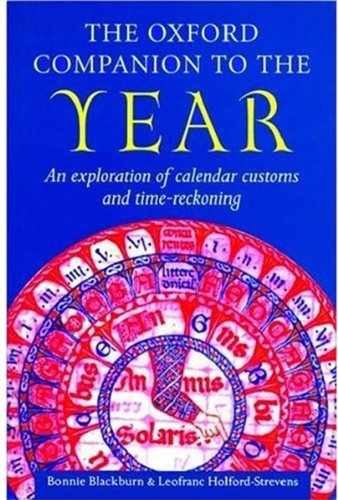
The Oxford Companion to the Year: An Exploration of Calendar Customs and Time-Reckoning
1999 · PDF